
What Does the SaaSpocalypse Mean for the Global South?
The death of SaaS is greatly exaggerated. The real story for emerging markets is the opposite: AI is making enterprise-grade software affordable and customizable for the first time.

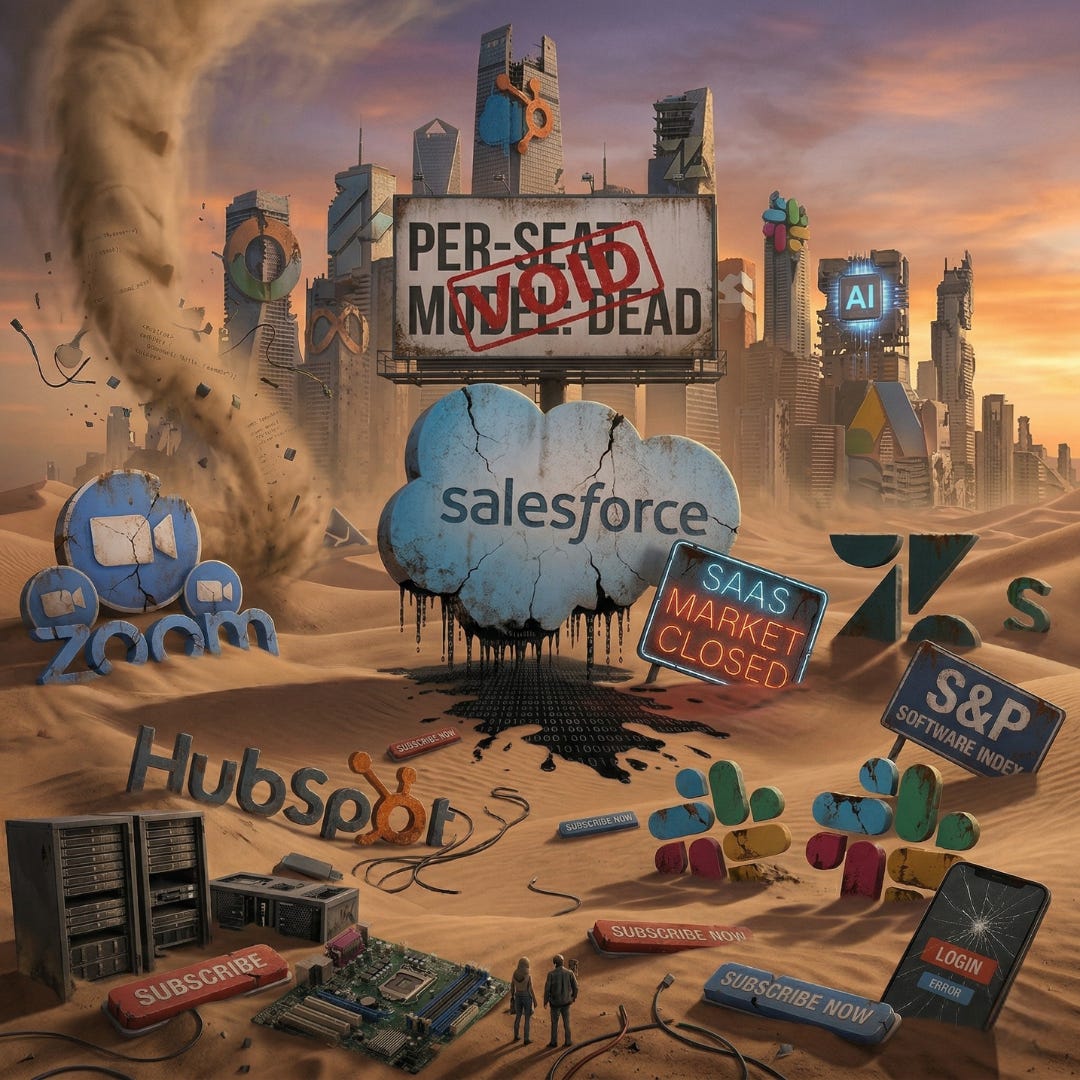
In February 2026, Anthropic launched Claude Cowork and Wall Street lost its mind. We all watched over a 48-hour period as roughly $285 billion in SaaS market capitalization evaporated. Thomson Reuters dropped 16% in a single day. The iShares software ETF entered a bear market. Traders at Jefferies coined a new term — the “SaaSpocalypse” — and within weeks, an estimated $2 trillion in software value had been wiped out.
The thesis seemed straightforward: if AI agents can autonomously handle the knowledge work that SaaS companies charge $30–$150 per seat per month to support, the per-seat model is structurally broken. Add the vibe coding movement — Y Combinator CEO Garry Tan reports that 25% of YC’s recent startups have codebases that are 95% AI-generated — and the fear is that companies will simply build their own tools rather than pay for SaaS.
The fear is real. The conclusion is wrong. And for investors in the Global South, the events that triggered the SaaSpocalypse are the best things that have happened to enterprise software since the advent of cloud computing.
The Death of SaaS Is Greatly Exaggerated
Let’s start with what the market is actually telling us. Software stocks have been hammered — the S&P North American Software Index traded below 20x forward earnings for the first time ever. But the earnings themselves? Still growing. Salesforce reported $41.5 billion in FY2026 revenue, up 10% year-over-year, with remaining performance obligations exceeding $72 billion. Snowflake grew revenue 30%. The disconnect between strong fundamentals and collapsing valuations is why many respected voices, including humble me, believe the selloff has gone too far. There will be price pressure over time and some companies will not create enough new value to compensate for lost margin, but leading SaaS companies can still evolve and grow.
Goldman Sachs CEO David Solomon called the selloff “too broad,” noting that “there’ll be winners and losers — plenty of companies will pivot and do just fine.” JPMorgan’s strategists described the market as pricing in “worst-case AI disruption scenarios that are unlikely to materialise,” pointing to “broken logic” in investors simultaneously believing AI will destroy all software while its capex fails to deliver returns. Wedbush’s Dan Ives called the selloff “a generational opportunity,” and Bill Gurley advised believers to “pick them up off the floor.”
I’m not a technical market analyst, and I won’t pretend to time the bottom. Many agree that the selloff was pricing in too much destruction, too quickly. But I believe the non-SaaS-insider bulls are closer to right than what the still-tanked market tells us today. Why? Outside the software industry itself, building and maintaining enterprise-grade software to address mission-critical business needs is not and will not become the core competency of any company. The idea that a logistics firm or a hospital chain will vibe code its own CRM or compliance system is, frankly, absurd. As Zoho CEO Sridhar Vembu pointedly asked: “Why don’t we see vibe-coded email or spreadsheet or accounting apps yet?”
That said, enterprise-grade agents are genuinely emerging. Agentic workflows combined with existing SaaS products can help companies move more quickly and at lower costs than ever before. The shift from per-seat to usage-based and outcome-based pricing is real — Gartner projects that by 2030, at least 40% of enterprise SaaS spend will shift to usage-, agent-, or outcome-based models. This is evolution, not extinction.
The Market Evidence: A US Valuation Problem, Not a Global Software Problem
Look at where the damage actually landed, and the pattern is clear. The SaaSpocalypse was fundamentally a repricing of overvalued US per-seat models — companies elsewhere that were never at those valuations didn’t have as far to fall.
In the US, the Goldman Sachs software basket crashed from roughly 34x forward earnings to below 20x. In Europe, companies that had reached US-style multiples fell in sympathy: SAP had its biggest daily loss since 2020, and Dassault Systèmes suffered its worst trading day in history (−21%) after reporting just 1% revenue growth. The sell-off punished any company trading at elevated multiples on the assumption of perpetual seat expansion.
India’s Nifty IT Index was hit hard — down 19% in February alone, its worst month since 2008 — but critically, this was driven by IT services companies (TCS, Infosys, Wipro) whose revenue comes from serving US and European enterprises. ICICIdirect estimated AI could dent 10–12% of their application development and maintenance revenue over 3–4 years. India’s domestic SaaS product companies — with Zoho as the shining star — are overwhelmingly private and serve global as well as local markets at more affordable price points. No SaaSpocalypse-specific crash.
In Brazil, Locaweb (B3: LWSA3) — the closest listed pure SaaS play — didn’t show a sharp SaaSpocalypse-driven decline; its multi-year slide predates AI disruption fears and is rooted in Brazil’s interest rate environment. TOTVS, Brazil’s largest ERP company, was absent from SaaSpocalypse coverage entirely. Across Africa and Southeast Asia, there was essentially no listed-market contagion — most SaaS startups are private, early-stage, and priced for local economies. As KPMG’s Marshal Luusa put it at the India AI Summit: “In Africa, AI must pay for itself early, or it doesn’t survive.”
The takeaway: the SaaSpocalypse is a correction for companies plugged into the US valuation ecosystem. Domestic SaaS companies in the Global South, serving local markets at local price points and local-currency economics, were largely insulated because they were never riding that bubble.
Why the Global South Should Be Paying Attention
Global SaaS was always priced out of reach. American and European SaaS tools are largely unaffordable for Global South companies beyond the largest multinationals. The cost structure of domestic enterprises in India, Southeast Asia, Africa, and Latin America has never supported $30–$150/seat/month costs. For most of these companies, the pre-SaaSpocalypse world was not one of SaaS abundance — it was a world of limited or no enterprise-wide software at all.
Agentic pricing changes the equation. Usage-based and outcome-based pricing models now allow direct correlation between AI token fees and business outcomes. A company pays for what the agent does, not for how many humans log in. As the Deloitte report on SaaS and AI agents notes, this shift makes enterprise software genuinely accessible for the first time.
Build-plus-buy becomes viable. The real opportunity isn’t “build vs. buy” — it’s “buy the platform, customize with agents.” Enterprises can adopt affordable cloud-based SaaS for systems of record, then vibe code point solutions for decision support and other areas aligned with localized needs that global SaaS would never address. Small models running on-premises and as edge AI on phones will reduce dependencies further. Open-source models — whose adoption is surging across Africa and the Global South — reduce reliance on any single provider.
Vertical SaaS with local moats is not exposed. The fastest SaaS growth globally is coming from largely un-digitized industries like healthcare, agriculture, and construction — precisely the verticals where Global South startups operate with local regulatory moats. As the cost of creating locally optimized SaaS falls, new opportunities emerge that were simply not economic before. The largely undigitized enterprises across the Global South will see options for affordable, locally-tuned digitization that did not exist before.
The Investment View
If I were a public equities buyer, I would buy historically low-priced SaaS companies that I believe have what it takes to evolve their models to agentic and usage-based pricing before competitive threats arrive. Deutsche Bank says the SaaSpocalypse has peaked, noting that it has not found “a single software company that expects a negative revenue effect from AI in 2026.” Software trading at a discount to the S&P 500 for the first time in modern history is either a historic buying opportunity or a permanent structural break. The companies still growing revenue at double digits, with $50–70 billion in contracted obligations, suggest the former.
As a Global South and India-focused VC investor in vertical AI, I see nothing but upside from the reduced costs, faster development times, and easier customization that agentic platforms provide. The SaaSpocalypse is a correction for overvalued American software giants. For the billions of people and millions of companies in emerging markets who were never served by those giants in the first place, it’s the beginning of something far more important: affordable, locally relevant, enterprise-grade software is becoming available, at population scale.
The real question today is not whether SaaS is dying. It’s whether AI will finally make it accessible to the rest of the world. I believe it will.
I just started writing a few pieces a month ago, (on EdTech/AI, SaaS/AI & GTM), posting them only on my new site, with the posting date generic. https://alancyates.com/#writing I'll continue and shift where / how I publish...
A similar view: https://alancyates.com/saas-evolution